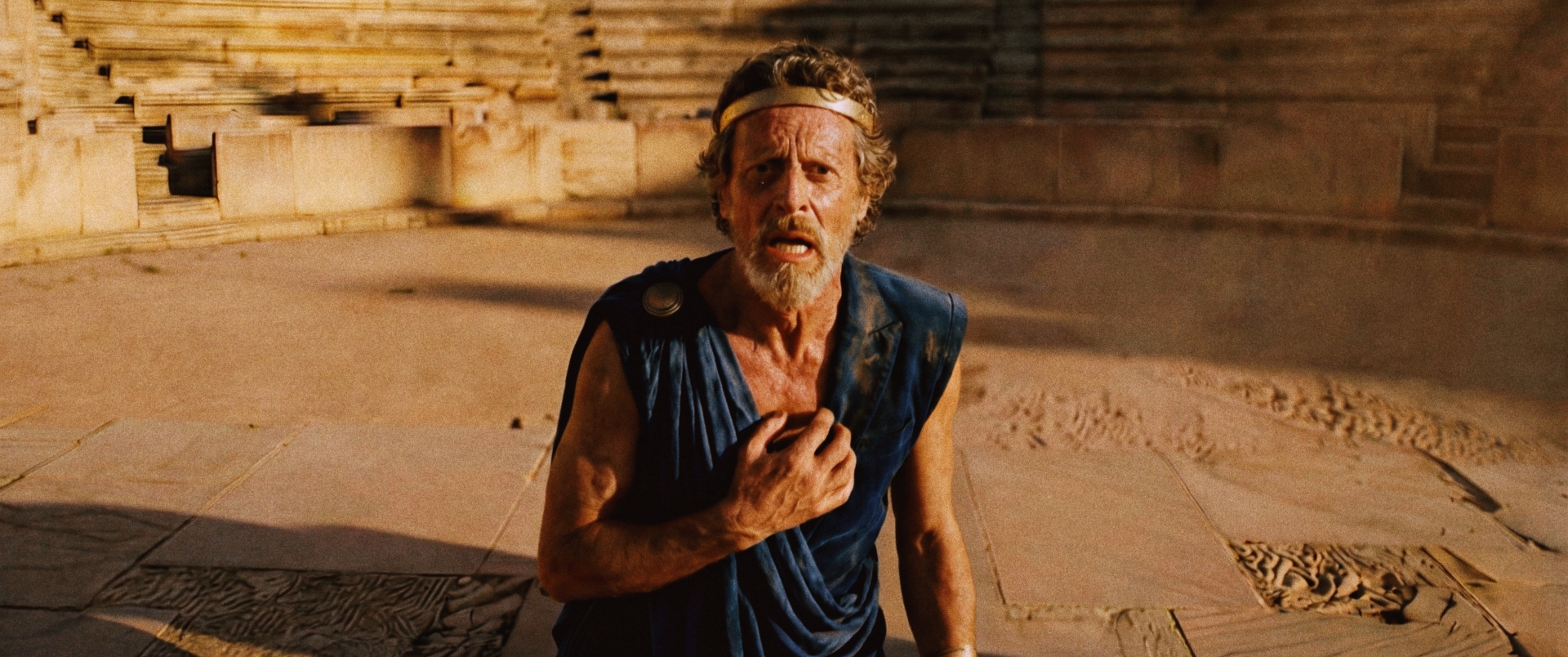
One word describes the film's style: probabilistic.
All images in the film are AI-generated. None tries to imitate reality.
Hence its visible signature: the mismatched cut — the jump cut and all its cousins. A face that changes from one shot to the next, a wall that shifts from paint to papier-mâché, a color that leaps, a background that reinvents itself. Where classical cinema would see only a continuity error, I made it a grammar — embraced, directed, claimed.
The echo with Oedipus is exact. Oedipus lives in the lie, and tells himself the same story a thousand different ways before admitting the truth. The film works the same material: fiction.
Not an imitation
AI can be used to imitate reality. It is possible to use it that way, and to observe its limits. A shot with five characters, a foreground, a background. The machine, when asked, must focus its limited attention. Prompting well is directing, allocating that attention. Beyond a threshold, it loses grip.
That threshold has a name: the attention mechanism, the breakthrough of the transformers — the “T” in GPT. The more you load a shot with elements, the further you pull the camera from a face, the more the AI cuts corners. That attention grows with each model: one day we will direct in 3D, the camera wherever we want, sets immutable as on a real shoot — but virtual. It will take years, not just one more model.
This film takes the other path. Discontinuities, state variations, probabilities are its vocabulary.
To simulate reality, you would instead have to lower your ambitions: short formats, a chamber piece, few elements — or an impoverished narrative, voice-over, little dialogue. I wanted neither. Rather than imitate cinema, I sided with what is deepest in AI: randomness. A probabilistic science, a statistical brute nicknamed a “stochastic parrot” by those who mean it as an insult. Instead of fleeing these artifacts like the plague, I made them a strength — not hallucinations, but an embraced variability.
Concretely: as Jocasta crosses the courtyard, the wall changes style and color behind her — palette-knife paint, papier-mâché, chalk. The faces too, sometimes brazenly: in one scene, the messenger does not have the same face from one shot to the next. I could have cultivated consistency; instead I widened the gap. Every variation, I sculpted it: variability, yes, but directed — my variability.
And that is the whole shift. Without me, the randomness would be there anyway: the AI would have let that wall drift, that face slip — slightly, just enough to jar. Accidents of its own, not mine: approximation. Since you cannot, today, obtain the same background twice, I chose to cut clean — on this shot, this paint; at this edit, that set. It is no longer an approximation left to the machine: these are contrasts I willed.
Density
Adapting Oedipus means first choosing between two stories. The drama — Oedipus's youth, already past when the play opens: the child cast out, the prophecy, the father killed on the road, the mother married unknowingly. And the tragedy — Sophocles's, which only begins once the drama is done.
For tragedy is not action, it is introspection. Everything has already happened. What remains is a man handed the truth — a hundred ways — and who, a hundred ways, refuses to see it. The denial plays out in speech. The play is a dialogued introspection: that is what I chose to carry, not the drama.
The drama would have made an almost silent film: visceral, carnal, shot through with the trouble of the bond to the mother, where gesture outweighs the word. That would have been the easiest path — for cinema as for AI. Action has a symmetry: two bodies in conflict answer each other, and that symmetry AI holds well. What it holds poorly is desynchronization — characters who do not do the same thing, who talk, evade, contradict. Dialogue, precisely.
I took the hardest road, for two reasons. Because that carnal side of Oedipus has already been brought to the screen in the 1960s, and magnificently: a film already made need not be made again. And because the wager was exactly there — to make AI sustain a spoken play, months of work on the voices, when everyone thinks it gifted for spectacle and clumsy in dialogue.
From that choice comes the density. The flow of words here owes more to theater than to cinema: something invasive, insistent, pressurizing, weighing on Oedipus — and, by contagion, on the viewer. This pressure is not a flaw of pacing: it is the vise of tragedy. Oedipus is under maximum strain; whoever identifies with him had to feel it too.
The audience does not watch the pressure that crushes Oedipus — the density makes them live it.
The pleasure of the print
Working with AI brings back a forgotten gesture: developing analog film. You compose an intent, you press, and you wait. The transformation happens in the dark. The image appears, and surprises us. The light, that face, that fold of fabric: we hadn't seen this.
There is, in that gesture, an interpretation by the AI of the intent and the data — one that can reveal things in the dark. It is its revelatory quality, the revelatory quality of the print.
Human presence
Mixing the real with the artificial: that mixture is a condition of the film. Alongside the generated images, the film makes an explicit place for forms that come from the physical world.
First, human models: the film's characters are built from photographs of people I know, who agreed to serve as models. That human presence, beneath the generated image, is not insignificant — it anchors the faces in a real that has existed.
Then, the work of the hands. The chorus of the Greek tragedy is not played by photographed models but by ceramic figurines, handmade: an articulated metal armature, ceramic bodies and heads, garments and wigs custom-made by a costumer. All of this exists physically, off the machine.
The animation of these figurines was first imagined in classic stop motion. A few tests were shot. But a feature-length film entirely in stop motion would have required far more than a year and a half — a titanic undertaking. AI lifted that barrier. In the end, the figurines move through AI motion, not stop motion: AI animates what human hands have built.
AI did not replace craft — it made it possible.
That is one of the deeper reasons for the enthusiasm that some — myself among them — feel toward this technology: it does not dilute the human gesture, it opens up the possibility of adventures that lay beyond reach in the paradigm of yesterday's world.
The manga analogy
Manga lives with two qualities of paper. Most pages: black and white on screen-toned paper. Here and there: color, on glossy stock — the luxury page. The difference is not artistic. It's economic: gloss is expensive, slow, and you can't treat everything that way without blowing up the schedule.
An AI film works the same way. Each model has its own texture, its own precision. The most recent ones — the glossy color page — give the finest image. Older generations — the screen-toned black and white — give the baseline.
The bottleneck isn't really the cost of models. It's time. When a single director takes on every prompt, the work is sequential. Fifteen people prompting in parallel would be fifteen directors: you could shoot massively with the most recent models. But a vision stands alone, and time doesn't compress.
The consequence: shots from the end of the film are made with more modern models than those from the start. Without redoing anything, quality naturally rises. You can choose to remake some older shots with today's models — exactly the move of redoing in color pages that were black and white. Many, but not all: otherwise the film never ends, and new models will have shipped before you do. Hence manga.
Day for Night, in the age of AI
This film took me two years. Not two years of compute — two years of directing. Because to make a director's film, carried end to end by a single vision, you have to intervene on every shot, every prompt, one by one. That is what directing is: not pressing a button, but talking — to every contributor, every department.
The finest definition of the job was filmed by Truffaut, in Day for Night: the director is the one who talks to everyone — the cinematographer, the set designer, the actors — to convey, shot after shot, what he sees in his head. Speaking to a crew or to the machine, the AI, the gesture is the same: one voice running through the entire film.
And a voice cannot be parallelized. You can shoot in two weeks, with thirty people prompting in concert — but then they are thirty directors, thirty eyes: a producer's vision, not a director-author's. I wanted the opposite: a single hand on every shot. The price is time — and time does not compress.
Thirty people in parallel are thirty directors. A vision, by contrast, stands alone.
This is where everything else comes from. The economy of the manga and the recency variations across the models, from one end of the film to the other, are not accidents: they are the traces of a single gaze that crossed two years of technology, shot after shot. Proof, on screen, that a human passed through — slowly, entirely.