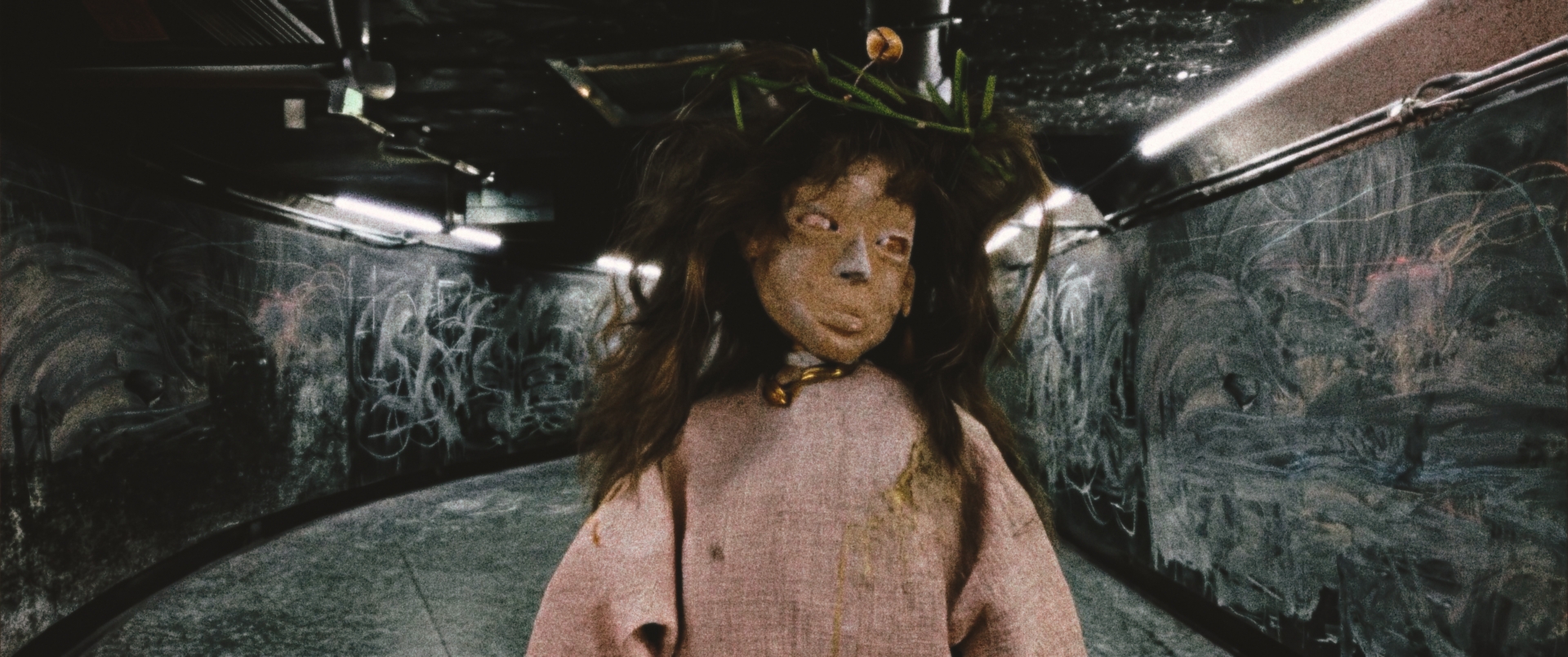
Three roads cross in this film. The reference is no accident: Oedipus killed his father at a crossroads of three roads.
The first: the artistic intent. Adapt Oedipus — the most human of myths — to the age of artificial intelligence.
The second: AI's massive production capabilities. The machine does not merely reproduce: it proposes, drifts, makes accidents. In practice, it surprises more often than it disappoints.
The third: code. Making a film with AI was not enough. The code itself had to be part of the work — not a workshop of stitched-together prompts, but an architecture in which the workshop participates of the subject.
The question of the model
The objection is well known: AI reproduces patterns, it does not invent. That's true — and it's true of us too. Our lives, our readings, our emotions are databases. When we write or shoot, we activate, like the machine, what we have learned to recognize.
Then there is the spark. Only the human would be able to ignite it, the AI not. What if the spark came from the very interaction of human and AI? It is precisely when the AI works with the human that the sparks can arise.
While making this film, I have seen AI produce things that looked, strangely, like an act of creation. Not by magic. By accident.
The brain dump
A film begins in the head. You envision, you imagine, you hold a vision — almost a dream. Then comes the other half: turning it into images and sounds. How do you give birth to pictures and voices out of what lives in the mind? Cinema has answered in a thousand ways; every director has their own.
For a film made with AI, what worked was the brain dump. And it ran, above all, through the voice. Where a writer works through the hand, here the vision is shaped by speaking — for to evoke a vision, to sculpt it, is to talk. Much as a director talks on set: with the production designer, the cinematographer, the actors, handing out ideas, images, references, music.
On a set, a great deal also stays unspoken — a mood, a presence that feeds the work in silence. But the machine needs material to read, and the voice is the most direct way to pour out what is in the head.
Then the tools take over. Speech-to-text turns voice into words; text-to-image, text-to-video, image-to-video turn words into pictures and motion. AI is, at bottom, a chain of transformations — and the brain dump feeds its first link.
I can talk at length, for several minutes, to describe a shot, a quality of light, an atmosphere, an actor's playing. That speech is analyzed, synthesized, summarized, then handed back to me as a prompt. From brain to voice, then from voice to prompt: this is the work — a sculptor's work, carving the prompt out of the raw text. AI is remarkably good at structuring and ranking what the voice throws out. And the voice covers vast ground: speaking, you brew ideas, you hesitate, you refine — you understand a little better what you mean, and see your own vision more clearly.
The brain dump: handing the mind's content to the machine in its rawest form, through language.
The human expresses their vision, the AI delivers, the human reacts and chooses, creation comes from the dialogue.